
May 2026 Newsletter
It Looks Small—But Is It? When a Horse Wound Needs a Vet
With summer approaching and more horses being turned out on sunny days, cuts and injuries become much more common. Many are minor and heal without problems—but some can quickly turn into something more serious if underestimated.
Understanding what kind of wound you’re dealing with is the first step in deciding what to do— and whether you need to call your vet.
The most common types of wounds
Not all wounds are the same, even if they look similar at first.
- Superficial wounds (abrasions)
These affect only the top layer of the skin and are often caused by rubbing or small knocks. They are usually low risk, as long as they are kept clean and checked regularly.
- Lacerations
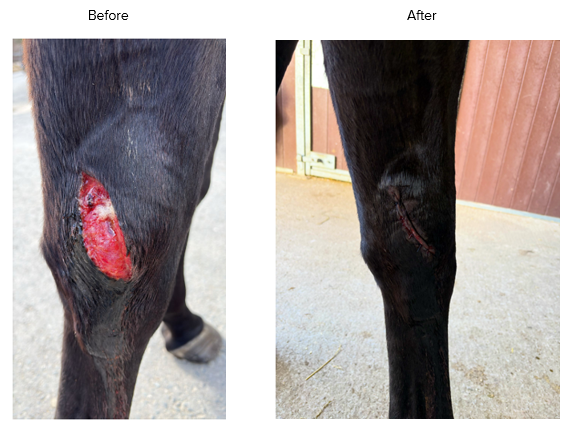
These are cuts with open edges. Some may look dramatic but stay superficial, while others can be deeper than they appear.
- Puncture wounds
These are small holes on the surface but can go deep into the tissues. They are one of the most commonly underestimated injuries—and one of the most risky if ignored.
- Contusions (bruising)
In these cases, the skin is not broken, but you may see swelling, heat, or pain. Even without an open wound, there can still be damage underneath.
- Wounds in critical areas
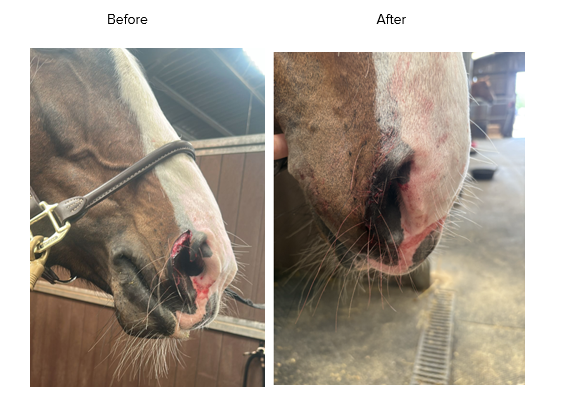
Wounds near joints, tendons, or involving the eyes and face always need extra care—no matter how small they look.
It’s not just the type that matters
When you look at a wound, don’t just focus on how big it is. Think about where it is, how deep it might be, and how your horse is behaving.
For example, a small wound near a joint can be much more serious than a larger, superficial cut elsewhere.
When you can manage it yourself (at first)
You can usually manage a wound initially if:
- it is superficial;
- there is little or no bleeding;
- there is no significant swelling;
- your horse is comfortable and not lame.
In these cases, keep the wound clean, apply a bandage if possible, and monitor it closely over the next few days.
If you notice swelling, heat, or lameness, it’s time to call your vet.
When you should call your vet straight away?
- Some situations should never be “wait and see.” Contact your vet as soon as possible if you notice: • a puncture wound;
- a deep or open wound;
- a wound near a joint or tendon;
- heavy or ongoing bleeding;
- clear lameness.
For bleeding wounds: apply a firm bandage and keep pressure on the area while waiting for your vet.
NB Early treatment can make a big difference to recovery and future performance.
What your vet may need to do?
- If a wound is close to a joint or tendon sheath, your vet may need to check whether these structures are involved. X-rays, ultrasound and pressure test are used to evaluate the extent of the wound.
During a pressure test, sterile fluid is injected into the joint. If fluid leaks from the wound, it means the joint is involved and the horse will need referral for joint lavage (a procedure to thoroughly clean the joint).
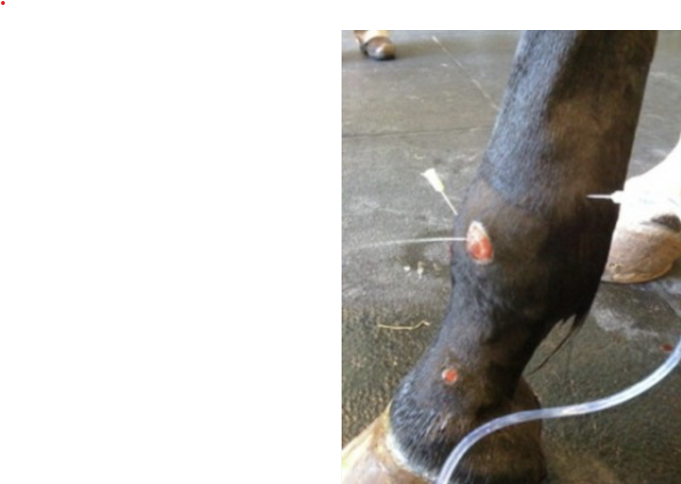
2. Timing matters: the first 24 hours are critical in these cases. If your horse becomes lame a few hours after you first noticed the wound, call your vet immediately.
3. Heavy bleeding
Stopping the bleeding is the priority. Your vet may place stitches or staples, or apply a strong bandage until the wound can be properly assessed. If you find your horse bleeding in the field, don’t underestimate it—blood loss can be significant. Call your vet straight away.
4. Wounds to the chest (thorax)
Make sure your horse is breathing normally. In some cases, an ultrasound is needed to check for deeper injury.
5. Puncture wounds in the foot
If your horse has stepped on something like a nail, do not remove it if possible. Your vet may need X-rays to understand how deep it is and what structures are involved.
Your vet may clean and close the wound and prescribe antibiotics and anti-inflammatories. Tetanus protection is also very important, especially if your horse is not vaccinated. If a wound can be stitched, the first 6–8 hours are the best window for treatment.
Final thought
Wounds are common—but knowing when to act makes all the difference.
If something doesn’t feel right, trust your instinct. It’s always better to ask early than deal with complications later.
Even a quick call or a photo can help your vet guide you in the right direction.
Take care,
Alice