

October 2025 Newsletter
ENDOSCOPIC EXAMINATION AT THE SALES
Autumn means sales season! After months of hard work, it’s time to watch our future champions head off to their new homes, where they’ll begin preparing for their racing careers. But before they reach the sales ring, there’s one crucial step left: a thorough endoscopic examination to ensure they meet the health standards required for sale.
Each sales organization may have slightly different criteria, but the main respiratory conditions to identify during scoping include:
- Laryngeal hemiplegia – Characterized by consistent immobility or failure to abduct (open) one of the arytenoid cartilages. Most commonly affects the left side.
- Rostral displacement of the palatopharyngeal arch – This may indicate a congenital abnormality known as fourth branchial arch defect.
- Epiglottic entrapment – The epiglottis becomes trapped beneath a fold of the soft palate, creating a characteristic “glove-like” appearance around it.
- Permanent dorsal displacement of the soft palate (DDSP) – The soft palate moves above the epiglottis. While this may occasionally occur and resolve on its own, persistent displacement where the epiglottis does not reappear is abnormal.
- Chondroma or severe arytenoid chondritis – Inflammation or infection of the arytenoid cartilages, which can compromise airflow.
- Subepiglottic cyst – A cystic formation located beneath the epiglottis.
- Cleft palate – An incomplete closure of the palate, usually affecting the soft palate, where an abnormal opening is visible.
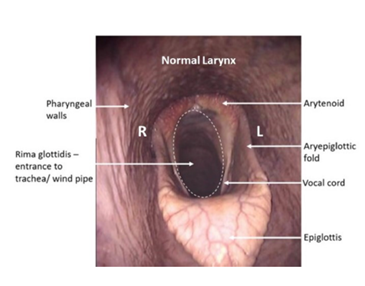
What Does a Normal Larynx Look Like?
The equine larynx consists of five cartilages, but during
endoscopy, we primarily visualize three:
- The epiglottis
- The left and right arytenoid cartilages
A healthy larynx should allow full abduction of the arytenoids during inspiration. This is essential for maximizing airflow to the trachea and, ultimately, the
lungs. Any restriction can reduce oxygen supply, affecting
muscle metabolism, leading to fatigue and decreased performance.
One of the few clinical signs of upper airway obstruction, besides poor performance, is abnormal respiratory noise during exercise—a symptom difficult to assess during sales. Therefore, endoscopy becomes a key diagnostic too.
What Does a Normal LarynLymphoid Hyperplasia in Yearlings
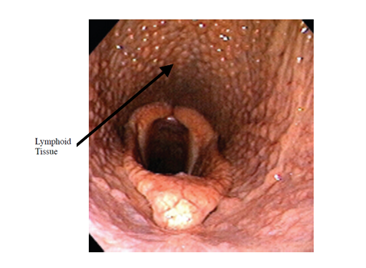
It’s common to observe lymphoid hyperplasia in young horses at the sales. This represents an overgrowth of lymphoid tissue in the pharynx and is generally a normal immune response as the horse adapts to new environments and microbial exposure.
What Are We Looking For During a Sales Scope?
Key structures to examine:
- Soft palate
- Epiglottis
- Arytenoids
- Surrounding pharyngeal tissues
We also:
- Stimulate swallowing to check for any dynamic displacements.
- Assess and grade the arytenoid movement using a standardized scale.
Arytenoid Movement Grading (Modified Rakestraw System)
Grade I: Normal, symmetrical, full abduction of both arytenoid cartilages.
Grade II: Slight asymmetry, but full abduction is achievable.
- IIa: Maximal abduction achieved easily.
IIb: Maximal abduction achieved with some effort or delay.
Grade III: Incomplete abduction (reduced movement).
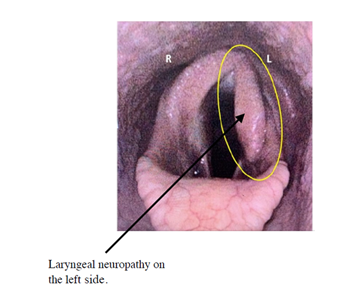
Grade IV: No movement (complete paralysis), often indicating recurrent laryngeal neuropathy, which typically affects the left side.
Surgical History Check During Endoscopy
It is essential to verify that the horse has not undergone any upper airway surgery, as certain procedures can affect performance or mask underlying problems.
Tie-Back Surgery (Prosthetic Laryngoplasty)
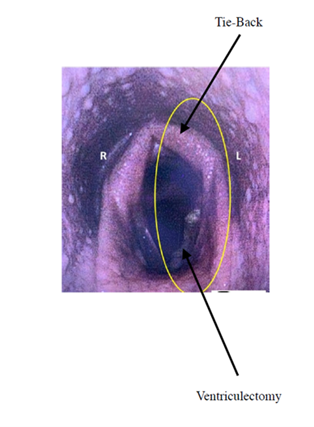
In this image, the left arytenoid cartilage (L) appears fully abducted (open), even though the right side (R) is relaxed. This is a typical sign of tie-back surgery, usually performed when the left side is paralyzed. A non-absorbable suture is placed under general anesthesia to permanently hold the left arytenoid in an abducted position, keeping the airway open.
Hobday or Ventriculectomy
In this case, the laryngeal ventricles (small pouches just above the vocal cords) have been surgically removed. This procedure is performed to enlarge the airway space at the entrance to the trachea and is often done alongside other surgeries to reduce abnormal respiratory noise.
Grading After Endoscopy
After your vet performs the endoscopy, they will assign a grade based on arytenoid function. Some veterinarians may also give an overall subjective grade for the appearance and function of the entire throat.This grading system is similar to a school report card and may include modifiers such as A+, A, or A−.
I hope you enjoyed this brief summary and found it helpful. Best of luck at the sales and with your future champions!
Best regards,
Alice