
November 2026 Newsletter
Atrial fibrillation is a very important cardiac arrhythmia and encountered more regularly than we would like. Despite some horses showing minimal clinical signs at rest (or even at exercise), the condition can have a significant impact on their exercising capacity and racing performance.
Atrial fibrillation can go unnoticed because horses, unlike humans, who may feel a fluttering sensation (palpitations), show limited blood flow changes, and therefore remain very calm and unphased when in AF. Subsequently, the arrhythmia often only manifests clinically when the horse is pushed very hard. This is because when resting, horses have a “brake” effect, meaning they can slow down electrical impulses through their atrioventricular node and keep the heart rate within normal range. However, during intense exercise, this ‘brake’ is removed therefore leading to a very high heart rate and sharp drop in cardiac output and stamina.
Many racehorses will suffer from a single episode of AF and recover without any treatment – we may never know it’s even happened.
1. What is atrial fibrillation?
Atrial fibrillation occurs when the normal electrical activity of the heart’s atria becomes disorganised.
Instead of contracting in a coordinated manner, the atria experience rapid, chaotic electrical activity. This disrupts normal atrial contraction and results in an irregular ventricular rhythm.
In horses, AF is the most commonly recognised pathological arrhythmia associated with poor athletic performance.
Some horses develop AF without identifiable underlying structural heart disease, often referred to as ‘lone atrial fibrillation’. In others, it may be associated with underlying cardiac abnormalities, particularly atrial enlargement or valvular disease.
2. Why does it matter in racehorses?
As we know, racehorses are operating under a serious cardiovascular load when galloping and there is a high requirement to deliver oxygen to their muscles. Atrial fibrillation reduces the contraction of the atrium which contributes to the filling on the ventricles and this has an overall effect of reducing their cardiac output. This is because the signals telling the heart to beat become ‘confused’ (for want of a better term) meaning that the ventricles are not filling properly before they contract, and therefore less oxygenated blood is being pumped around the body, meaning the muscles are effectively being starved of oxygen.
How this may present to us:
- Reduced exercise tolerance both during training and races
- Inconsistent race results
- Poor recovery following exercise
- In rare cases, collapse or sudden cardiac death
It is worth noting that these horses may appear completely normal at rest!
3. Diagnosis: identifying the problem
Accurate diagnosis is essential before decisions about treatment can be made.
Electrocardiography (ECG)
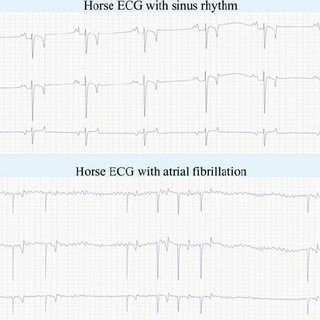
An ECG is the principal diagnostic investigation for AF. Characteristic findings include an irregularly irregular ventricular rhythm, absence of normal P waves and the presence of fibrillation waves.
We carry a handheld device that connects to our phones called a Kardia. This is often used if we are suspicious of atrial fibrillation following listening to the heart with a stethoscope. This allows us to get a quick visual reading of the heart rhythm.
Following this, if the heart has not resumed normal rhythm within a few days, we may perform an overnight ECG to get an extended window of data over 12 or so hours to see any variability in their heart rhythm.
Exercise ECG monitoring
When their heart sounds normal at rest, and is also normal on an overnight ECG, we will monitor their heart rhythm during exercise.
Echocardiography
Ultrasound examination of the heart helps identify structural abnormalities, assess atrial dimensions and investigate underlying valvular disease.
4. Treatment and management
The appropriate treatment depends on the duration of AF, the presence of underlying cardiac disease, the horse’s intended athletic use and its overall clinical condition.
Two established approaches to restoring normal sinus rhythm are:
Pharmacological cardioversion
A common treatment medically is by using repeated doses of quinidine sulphate. We will refer your horse to a hospital to do this as there are occasional side effects and risks associated.
Studies have shown that this treatment method is successful on the whole and success rates are improved if the horse has been in AF for less than 4 months, and also has a resting heart rate of less than 60bpm.
Transvenous electrical cardioversion (TVEC)
The aim of this treatment is to ‘shock’ them back into a normal rhythm using a very high electrical energy, similar to what you see done to humans in the emergency room on casualty! This is done with the hoses under general anaesthesia so therefore comes at a higher cost than medical conversion.
This technique is only used if there are no other cardiac issues present.
The timing of treatment is important. Recently developed AF may resolve spontaneously, whereas prolonged AF can lead to electrical and structural changes within the atria that make successful cardioversion more difficult.
5. What is the prognosis?
The prognosis for returning to athletic performance is generally good! Especially if atrial fibrillation is the only current cardiac condition.
However, unfortunately, successful cardioversion does not guarantee that AF will never recur. In fact, there is current research demonstrating that horses with a previous history of AF are at an increased risk of encountering a subsequent episode. It is essential that we keep monitoring these horses following treatment. Interestingly, it has been discovered that a slow gradual return of these horses to full work might reduce the risk of early reoccurrence.
Anyway, its not all doom and gloom, and the sooner it is diagnosed the better! Therefore, it is a condition worth knowing about and getting in touch if you have any concerns!
Best wishes,
Molly