
October 2026 Newsletter
Sinus Problems in Horses: More Than Just a Snotty Nose
A snotty nose is something most horse owners will notice at some point. But when does a simple nasal discharge become something worth investigating?
Your horse’s head contains a surprisingly complex network of air-filled spaces called sinuses. They are normally quiet and trouble-free, but when they become infected, blocked or affected by dental disease, they can cause a variety of signs that are easy to overlook.
Let’s take a closer look at what the sinuses do, what can go wrong, and whether a sinus problem always means surgery.
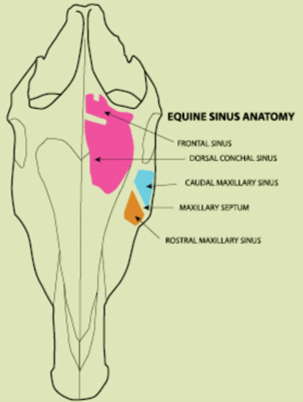
First things first: What are the sinuses?
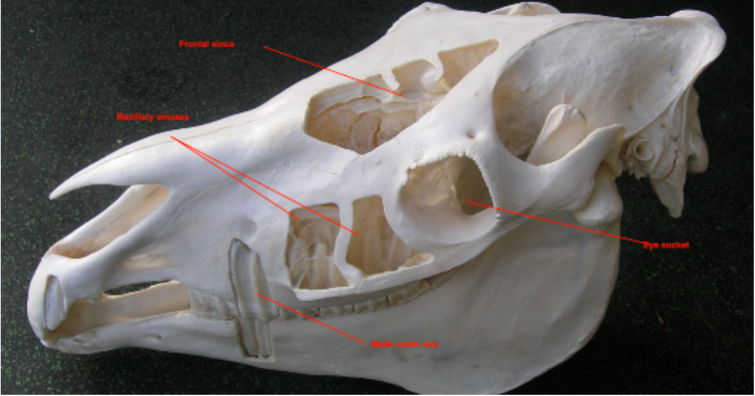
Think of the sinuses as a series of air-filled spaces inside your horse’s skull.They sit around the nasal passages and behind the cheekbones, close to the eyes and, importantly, very close to the horse’s upper cheek teeth. This close relationship with the teeth is important because dental problems can sometimes lead to sinus problems.
What is sinusitis?
Sinusitis is the inflammation or infection of one or more of the sinuses.
The condition may be primary, meaning that it originates within the sinus itself, or secondary, meaning that another condition affects the sinus.
Possible causes include:
- Dental disease;
- Trauma, such as a bone fracture;
- Abnormal tissue growths, such as cysts.
Treating the infection alone may not always solve the problem. We need to understand why it occurred in the first place.
When should you start to worry?
One of the most noticeable signs is nasal discharge. However, not all nasal discharge indicates sinus disease.
Signs that may make us more suspicious include:
- Discharge that keeps coming back or does not improve;
- Discharge coming from only one nostril;
- Thick or unpleasant-smelling discharge;
- Swelling around the face or underneath the eye;
- Sensitivity or discomfort around the face;
- Changes in chewing or eating;
- Occasionally, increased tearing from one eye.
A particularly useful clue is persistent, one-sided nasal discharge.
If you notice this in your horse, it is worth having them checked rather than simply waiting for it to disappear.
Your vet will usually start with a thorough examination, including an assessment of the horse’s face, nose and mouth.
Depending on the findings, further investigations may be recommended.
These might include:
- Dental examination: To check that all the teeth appear healthy and to identify any potential dental problems.
- Endoscopy: This can often help identify the source of the discharge. For example, it may be possible to see pus draining from one of the sinus openings into the nasal passages.
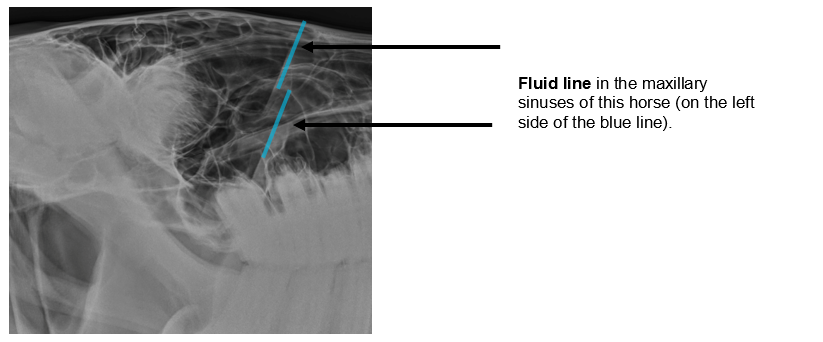
- X-rays: If the sinuses are involved, X-rays may reveal what is known as a fluid line. Normally, the sinuses are filled with air. If fluid accumulates due to infection or inflammation, the boundary between the air and fluid may be visible on the X-rays. Think of it like a glass half-filled with water, where you can clearly see the boundary between the water and the air above
CT imaging: This can be especially helpful because it provides a detailed view of the structures inside the skull. It can help identify exactly which sinus is affected and whether a tooth or another structure is involved.
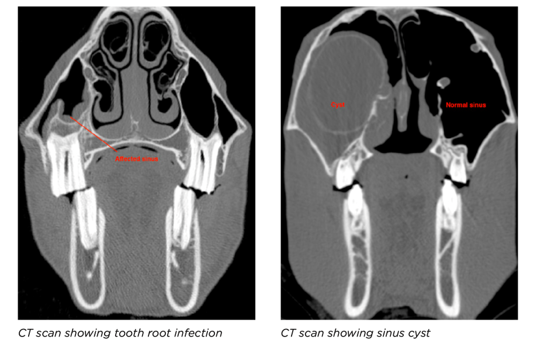
The goal is simple: find the cause, not just treat the symptoms.
Does a sinus problem always mean surgery?
Not at all!
The right treatment will depend on your horse, the cause of the problem and which sinus is affected.
If the condition is primary and no other structures are involved, a course of antibiotics may be enough to resolve the infection.
If antibiotics alone are not sufficient, a sinus flush using a needle may be performed at the yard under standing sedation, once X-rays have confirmed which sinus is affected.
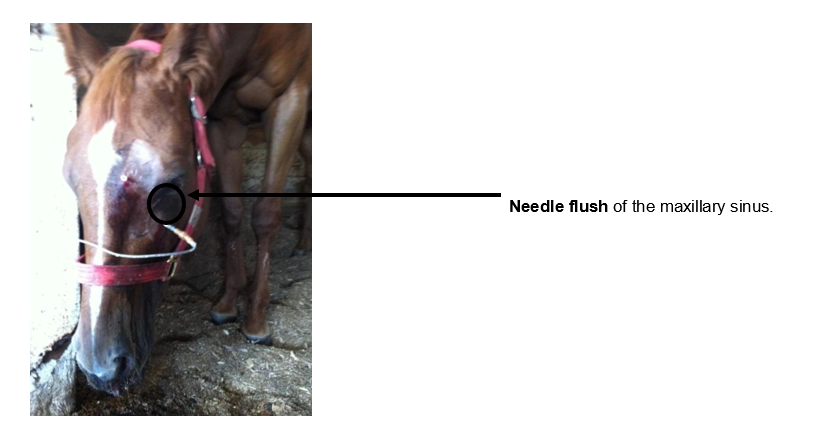
When this approach fails to resolve the problem, or when the sinusitis becomes chronic, the horse may need to be referred for surgery.
The take-home message
A little nasal discharge does not necessarily mean something is wrong.
However, if your horse develops persistent, one-sided discharge, an unpleasant smell, facial swelling or changes in eating or chewing, it is worth seeking veterinary advice.
Sinus problems can sometimes be surprisingly subtle, and the earlier we investigate them, the easier it can be to identify the underlying cause and choose the right treatment.
So, next time you notice your horse has a runny nose, take a closer look. It might be nothing, but if it keeps coming back, your horse may be trying to tell you something.
Best wishes,
Alice